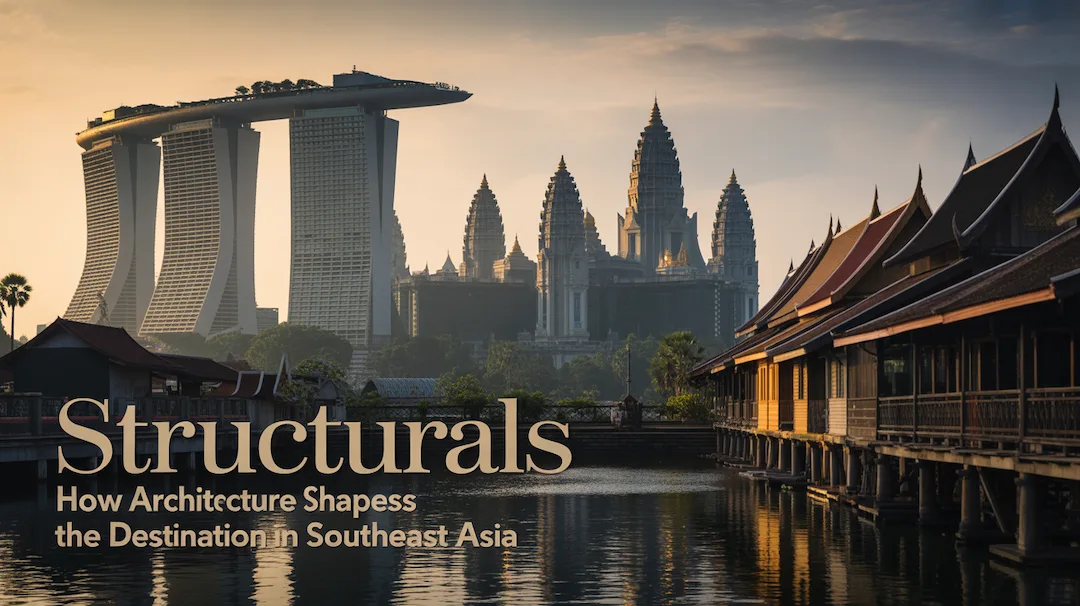
In the world of travel, we often speak of “atmosphere” as an abstract concept—a feeling that washes over us when we step off a plane. But for the discerning observer, atmosphere is not accidental. It is engineered. It is the result of deliberate choices in geometry, material, and spatial planning. In Southeast Asia, a region often categorized by its chaotic street life and raw natural beauty, there is a parallel narrative of architectural evolution that quietly shapes the traveler’s experience. From the royal heritage of the Thai coast to the emerging sports-centric urbanism of the northeast, the built environment tells the true story of the destination.
Content
The Heritage Vernacular: Hua Hin’s Royal Legacy
To understand the roots of Thai hospitality design, one must look to the Gulf of Thailand. Unlike the rapid, concrete expansion of modern resort towns, Hua Hin possesses a lineage rooted in the early 20th century. This was the era of the railway, when the Thai aristocracy sought respite from the Bangkok heat. The architecture here reflects that “Old Siam” elegance—a fusion of Victorian colonial influences and traditional Thai tropical living.
The design language of a Hua Hin resort is characterized by the use of teak wood, wide verandas designed to capture the sea breeze, and elevated structures that respect the coastal topography. It is a place of manicured topiary and quiet symmetry. Choosing to stay here is not merely a lodging decision; it is an immersion into this preserved aesthetic. The best properties understand that luxury is spatial. They prioritize low-rise structures that sit humbly beneath the coconut palms rather than competing with them. The use of lattice work, cooling white stones, and water features creates a “corner” of the world that feels suspended in a more gracious, slower era.
The New Typology: Buriram’s Sport-Centric Urbanism
In stark contrast to the historical preservation of the coast is the radical transformation of the northeast (Isan). Historically an agricultural province, Buriram has reinvented itself through a singular, modern architectural typology: the stadium. It is now known as the “Thunder Castle,” a city defined by Formula 1-grade racing circuits and massive football arenas.
This shift has necessitated a new wave of hospitality design that is arguably unique in the region. The challenge: how to integrate the warmth of Thai culture with the sleek, high-octane aesthetic of modern sports? A stay at a hotel in Buriram answers this question. The architecture here often mirrors the dynamic lines of the stadium—using steel, glass, and team colors—while softening the interiors with local Isan textiles and craftsmanship. It creates a “sport-chic” vernacular that feels energetic and propulsive. This is a corner of Thailand where the built environment is entirely forward-looking.
The Transit Transition: Designing for Flow
Finally, there is the architecture of transition. For decades, airport zones were considered “non-places”—sterile vacuums of fluorescent light and waiting. However, as travel becomes more fluid, the infrastructure surrounding major hubs is evolving.
The modern transit hub is no longer just a holding cell; it is a bridge. The design of a convenient Don Muang airport hotel now prioritizes soundproofing, efficient flow, and smart connectivity. We are seeing a shift toward “functional luxury,” where the architecture serves the specific needs of the global nomad. Elevated walkways connecting terminals to lobbies, minimalist interiors that reduce sensory overload, and communal spaces designed for co-working reflect a changing world.
Beyond Borders: The Urban Jungle
This architectural narrative extends beyond Thailand. In Malaysia, the capital city offers a masterclass in vertical living. A Kuala Lumpur hotel places you in the heart of a skyline defined by the Petronas Towers. The design here is about maximizing the view, using floor-to-ceiling glass to turn the city lights into a living wallpaper. Meanwhile, across the Mekong, Laos is developing a softer, more colonial-French fused aesthetic. A Vientiane hotel often features shuttered windows and courtyards, reflecting a slower, river-bound pace of life.
Whether it is the colonial echoes of the coast or the kinetic energy of a sports city, these diverse regions offer a lesson in how architecture shapes our journey. The walls around us are speaking, telling us exactly where we are in the world.